
Baltimore County Previous Residents Sources
A backward address search in Baltimore County draws on sources with different answers. Each source answers its own question. Pull the current parcel's deed reference from SDAT Real Property. You can also pull it from the county GIS parcel layer. That Baltimore County reference points to the recorded transfer. Historic directories, federal census schedules, probate files, and obituary holdings then supply dated household clues. Baltimore County has no incorporated municipalities. A postal label like Towson or Dundalk leads to no separate city records office. Write down the county, the custodian, and the event date every time. The trail stays honest that way.
| Trail source | Verified local span | Custody or access | Address clue |
|---|---|---|---|
| Land-record series | Indexes begin 1655 or 1659, by series | MDLandRec, clerk, or State Archives | Recorded parties, legal description, book and page |
| Circuit Court land indexes | 1851-1921 and later series | Archives descriptions, clerk, microfilm | Links between post-1851 conveyances |
| Directories and telephone books | Telephone runs begin in the early 1920s; other runs vary | Pratt and county repositories | Dated dwelling or subscriber lead |
| Federal census | 1790-1950 | NARA and library databases | Enumerated household, subject to boundary checks |
| Probate and obituary files | Series and collection dates vary | Orphans’ Court, BCGS, HSBC, Archives | Estate or death context around a transfer |
Start with the question you are actually asking. Do you want to know who owned a Baltimore County property over time? Follow the deed trail first. Do you want to know who lived in a dwelling during a given period? Start with a city directory or census. For tracing previous residents in Baltimore County, the two paths should converge on something solid. Look for a matching date, a dwelling entry, or a legal parcel description. Ownership alone never proves occupancy. Let the records shake hands before you trust a connection.
Note: A dated ownership record and a dated household record work best together. Neither one alone lists every occupant of an address.
Baltimore County Deed References
SDAT bridges a street address to a land record. The Baltimore County GIS layers do the same. The parcel display can show a premises address, owner name fields, and tax mailing address. It also lists map and grid numbers, parcel, PIN or TAXPIN, legal description, and DEED_REF. Keep the premises address and the mailing address separate. A tax correspondence address may sit elsewhere. It does not prove the owner lived at the Baltimore County property. The DEED_REF also outlasts a modern street number. Tracts were subdivided, and street labels changed over the decades.
The MDLandRec instructions lay out the Baltimore County route. Pull the book and page from SDAT or GIS first. Then jump straight to that book/page. You can also use the name index. Maryland's current Version 5 remote workflow requires an account and a security code. When a simple current search ends early, try the historical and retired index paths. Confirm live image access, or any current remote-page condition, before you rely on it.
MDLandRec's official search guidance shows the book/page and party-search route. That route anchors a Baltimore County deed trail.
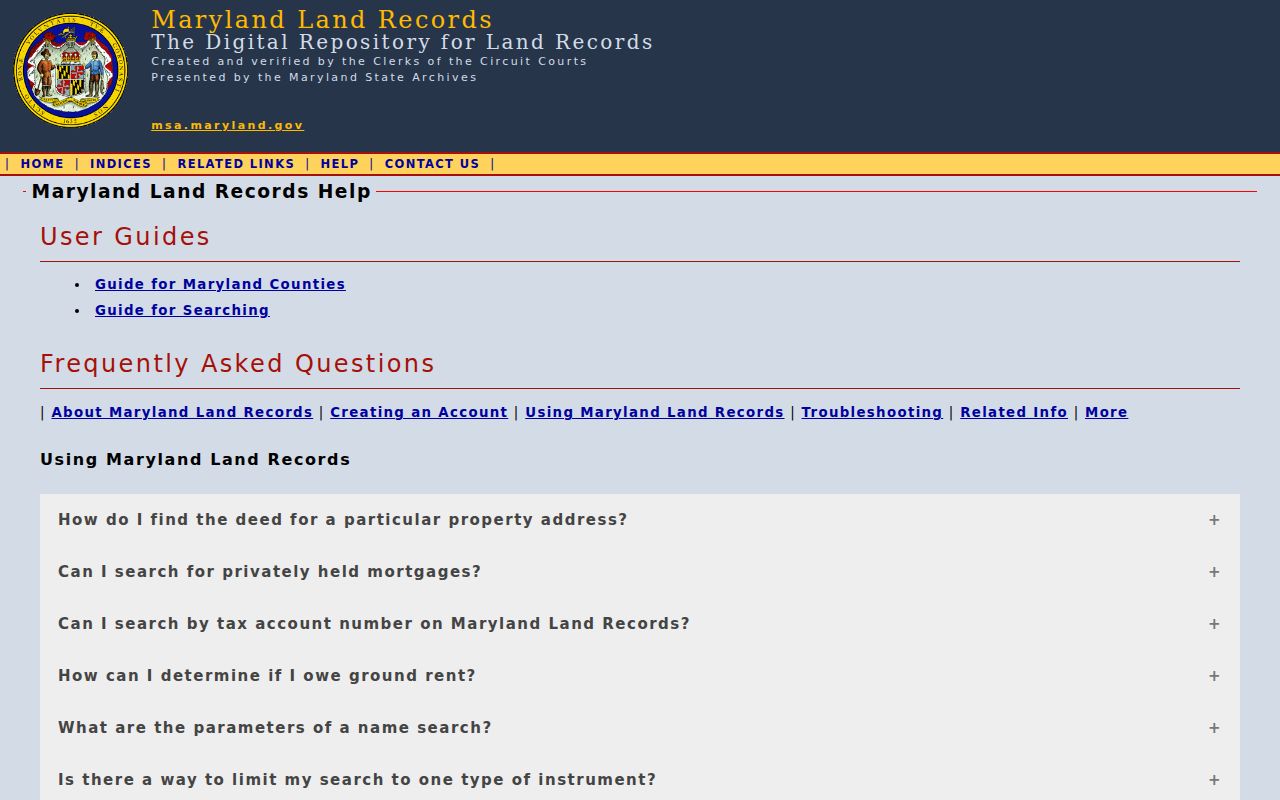
The screen highlights one core limitation. Baltimore County land records cannot be searched by street address. The parcel's reference is what carries you from property data to the deed image itself.
Trace Baltimore County Previous Residents
In a Baltimore County deed, the grantor transfers an interest and the grantee receives it. A chain of title is simply the sequence of recorded transfers for one parcel. It is not a roster of every person who used the address. Read the deed image itself rather than stopping at an index line. Note the parties and the recording date. Note the instrument type and the legal description. Note the liber and folio, and any earlier book/page reference. Search each party on both sides of the transaction. The purchaser in one deed may show up as the seller in a later one. A named party may turn out to be a trustee, an estate, a corporation, or a spouse.
- Find the property card through SDAT or the county parcel layer. Save the premises address, map/grid/parcel, PIN or TAXPIN, legal description, and DEED_REF.
- Open the Baltimore County book/page in MDLandRec, then read the current instrument image or request the clerk’s copy if the online image is unavailable.
- Write down the grantor, grantee, recording date, instrument type, and prior-reference clause. Compare the legal description with the property card.
- Search the seller as a grantee to locate the earlier purchase. Test spelling variants, initials, Soundex, legal capacity, and both party roles when names are common.
- Repeat until a cited reference is absent, the index changes, or the historic record needs a clerk, Archives, paper, or microfilm search.
- Grantor
- The party conveying an interest in the recorded instrument.
- Grantee
- The party receiving that interest in the instrument.
- Legal description
- The tract, lot, map, grid, parcel, or metes-and-bounds wording that identifies land more reliably than a street label.
- Chain of title
- A sequence of recorded transfers tied to the same legal parcel, not proof of every household member.
Tracing past residents of Baltimore County works best one property at a time. The ownership chain of a single home is not a current resident roll. For a street-by-street view of who lives in the county now, the Baltimore County street directory is the better tool.
Baltimore County Older Deed Paths
Older deeds in Baltimore County rarely begin with a single tidy starting year. The colonial-era land series run deep: CE32 grantee and CE33 grantor material spans 1655-1851, CE66 court land records covers 1659-1851, and CE34 early index material reaches from 1659-1800. CE35 continues the trail as a Circuit Court index for 1851-1921. Beyond those, clerk volumes, later original and corporate indexes, and microfilm carry the work forward. The Maryland State Archives deed guide sorts out which series or custody route fits a given parcel.
Jurisdiction matters here. Baltimore City split from the county in 1851, so a record stamped Baltimore may not belong to the county at all. Read the date, legal description, city or county designation, and series description side by side before drawing conclusions. A missing link can point to an unindexed volume, transferred custody, a predecessor jurisdiction, or restricted material. Gaps deserve evidence, not an old courthouse-fire tale.
Once the online path runs out, call or visit the Clerk of the Circuit Court for Baltimore County at the County Courts Building, 401 Bosley Avenue, Towson, MD 21204. The office is open weekdays, 8:30 a.m.-4:30 p.m.; the main number is 410-887-2601 and land-record indexing is 410-887-3088. Public terminals and staff assistance are available. Copies can be requested online, by email, mail, phone, or in person, and Maryland Courts guidance lists $0.50 per page for land-record copies; certified-copy fees should be confirmed with the clerk. For a county-held property record outside the land books, write to the responsible custodian. The clerk cannot create a new record on request.
The MDLandRec FAQ offers a sound closing habit: check retired indexes, verification details, plats, and the original custodian whenever a link fails to appear online.
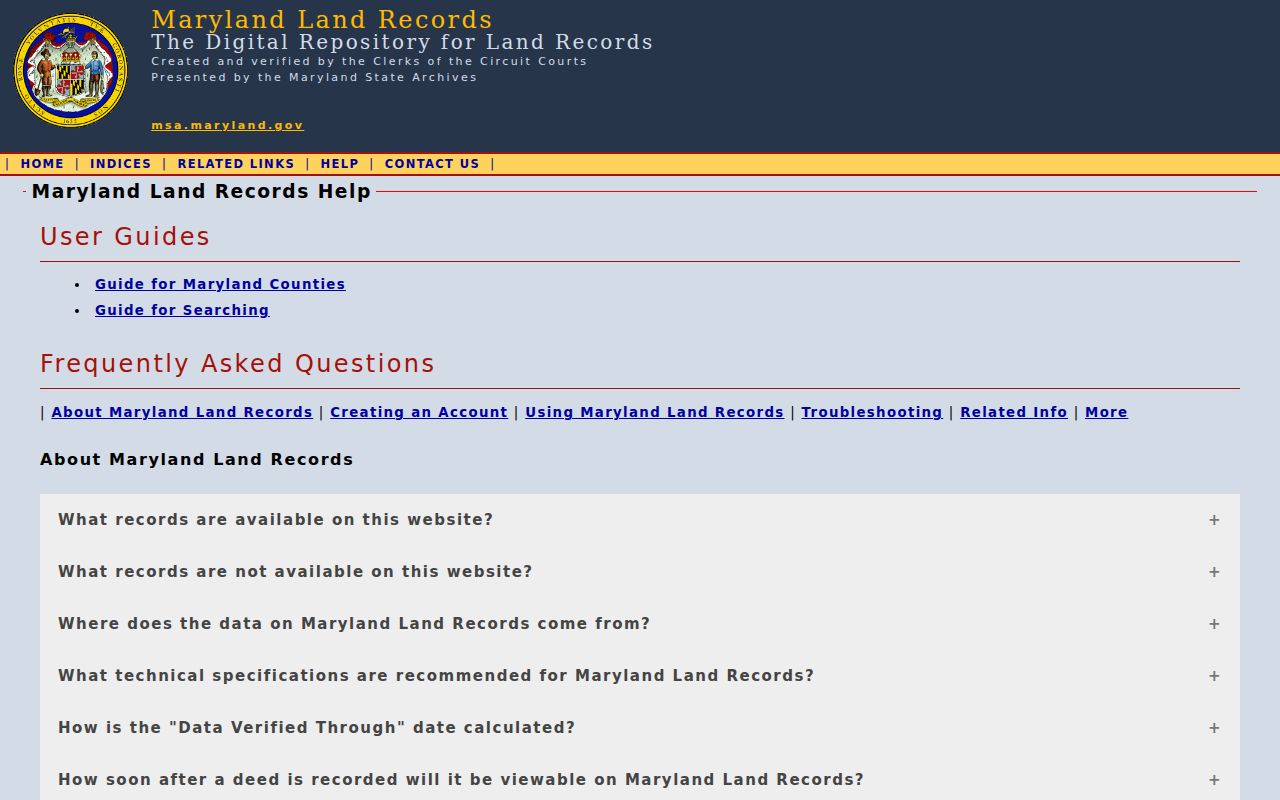
An online hit for older prior residents is a signpost, not the destination. The next usable volume may sit with the clerk, on a courthouse terminal, or in an Archives series.
Note: Record each series name and date range in your notes, since an index label alone does not prove complete coverage.
Baltimore County Past Households
Past households come into focus at the Baltimore County dwelling level through a dated house line, a census entry, an obituary, or a probate record. The Enoch Pratt Free Library Maryland Department holds city and county directories, reverse telephone directories, maps, atlases, and telephone directories reaching back to the early 1920s. Its house-history guide shows how to weave directories, maps, newspapers, deeds, and assessment records together. One caution applies. A directory may list a business line where you expect a dwelling, so read the full entry along with the title's place and year.
Set each directory year beside the closest public federal census. NARA releases schedules through 1950 under the 72-year rule. Before deciding a record matches one address, compare the street form, jurisdiction, enumeration district, and neighboring households. The Baltimore County city directory page describes the historical collections in detail, and they serve well here as dated checkpoints along a property trail.
Pratt's house-history guide models the working mix of maps, assessment data, deeds, directory entries, and newspapers when a Baltimore County address shifts over time.
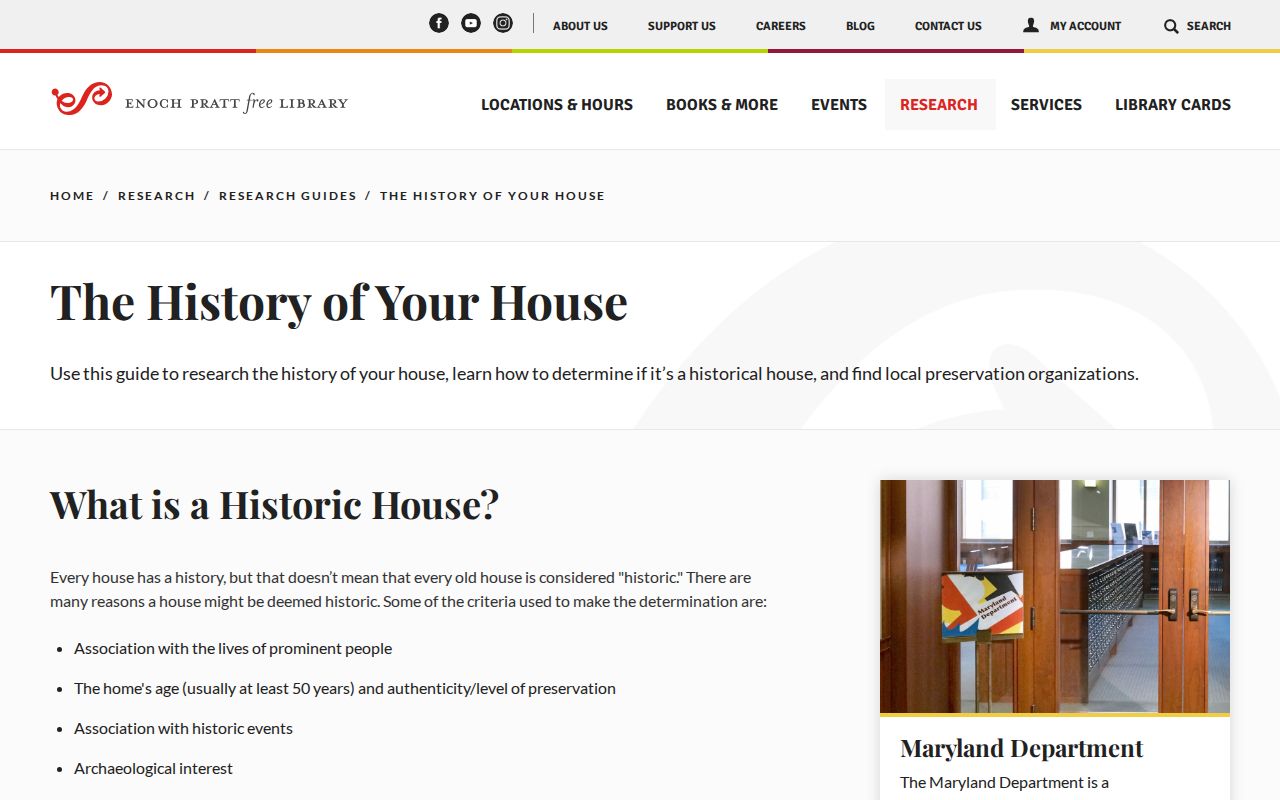
That method supports a careful address history: map the parcel first, verify the transfer next, then place each household clue in its correct year rather than trusting one source alone.
Baltimore County Directory Pairing
A simple date sequence keeps Baltimore County households from blurring together. Start with a sale or recording date from the deed. Then hunt for a directory or telephone listing near that year. Follow with the closest census schedule and a map or street index. Check titles closely. Digitized volumes such as the 1827 Matchett's, the 1875 Woods, and the 1891 R.L. Polk directory are city-centered works. So none can be called a complete Baltimore County household directory.
- Place the deed date and parties on a timeline for the parcel.
- Search an appropriate directory, reverse directory, newspaper, or repository file for a dwelling clue near that date.
- Compare the address with the nearest census year, accounting for county and city boundaries and historical street forms.
- Record the source title, volume, page or image, date, and whether the line is a dwelling, business, or subscriber entry.
The Historical Society of Baltimore County keeps a noncirculating collection of city and county directories, yearbooks, surname files, cemetery material, maps, and vertical files. Contact the HSBC library before traveling or mailing a research request. The reward is evidence tied to time, not a promise that every prior resident appeared in print.
Baltimore County Estate Clues
A Baltimore County transfer tied to an estate often explains a sudden change. It can shift the deed chain abruptly. For a deceased prior owner, start from the recording date. Then check obituary and cemetery leads. Next, locate the probate docket, will, inventory, account, or administration record. These records sit at the Register of Wills and Orphans' Court. The county's historical series include administration-account indexes, inventories, guardianship material, wills, and estate dockets. An estate paper may name a personal representative or heir. It still cannot prove where each heir later lived.
The Baltimore County Genealogical Society library rounds out the picture. Its holdings include obituary entries, family genealogies, marriage notices, burial abstracts, census indexes, and surname files. Its published rules report more than 10,000 obituary entries and a ten-page copy limit. Treat the index as a lead only. Connect a person to a property only after checking a deed, court record, or original notice. Any other dated source works too.
Note: Record an estate case number and the exact document type. A name in probate can represent several different legal roles.
Baltimore County Address Limits
A property roll names recorded parties and lists tax or parcel fields. That is where its reach ends. No roll captures every occupant, family member, or utility customer at an address. Private mailbox users and protected persons stay off these records too. A residents directory line carries the same limit. Each entry is just a publisher's dated listing, not proof of ownership, family composition, or continuous presence. Baltimore County previous residents research works best with plain claims. It should state what a record places at the property and leave the rest unclaimed.
Lawful use. Use house-history and family-history records with care. Maryland law prohibits stalking, harassment, and malicious surveillance; do not use an address trail to watch, threaten, or harm a living person.